
Lead: hiring without a black box
At IT Career Gym we believe a dream team is the critical lever. For many leaders, hiring is still a black box: gut feel, hope, and “seems like a decent person.”
Topgrading opens that box. Bradford Smart laid the method out in the late 1990s in Topgrading: How Leading Companies Win by Hiring, Coaching and Keeping the Best People. It is a structured way to find strong people — not only at C-level: it works for managers, team leads, and ICs.
This is not about filling a seat. It is about systematically adding people who pull, not people who service the process.
While you read — do not copy an ATS: the hiring manager keeps the Scorecard internally; the candidate narrates the past on a mock. Employers without a “HH-style” vacancy builder — the hiring landing.
Who is an A-Player
If you could describe an A-Player in one sentence:
An A-Player is someone you, as a manager, would enthusiastically re-hire in a heartbeat.
They are roughly the top 10% of available talent for a given role and salary. They do not “meet expectations”: they exceed them, fit the culture, and start delivering in the first weeks.
B-Players
Solid, reliable, comfortable to keep. No wow. Action: develop or re-evaluate. Coaching may lift them to A — or make it clear they will not get there.
C-Players
Low performers who often poison morale. Action: fast. They eat disproportionate manager time and drag the team down — they need to be moved out.
The goal
A team where everyone is an A-Player. Not “average plus a couple of stars.”
The “Hell, Yeah!” principle
A good hire feels like a win, not a relief (“at least someone showed up”). When an A-Player joins, you should think: “Hell, yeah! That was the right call. I would hire them again in a second.”
Per Smart and Foolproof Hiring, A-Players combine intelligence, drive, and emotional intelligence. A short list — not a checklist for hiring a robot:
- Sharp mind and business context: they learn fast and see past their ticket.
- Intrinsic motivation and care for the work, not only the grade.
- Honesty and the ability to build trust.
- Repeated high performance, not a one-off spike.
- Adaptability: different people, situations, failures.
- Ownership: they own the outcome, not the status of “I did what I was told.”
- A-Player magnet: they gravitate to other strong people and often build strong teams.
- Work ethic and resilience under load.
- Resourcefulness: they route around obstacles instead of reporting “blocked.”
- In leadership roles — they can lead, not only be the best IC.
- Humility and self-awareness: they know their weak spots and want to learn.
A candidate cannot paint these traits on LinkedIn. They show up in a pet project and on a mock. For employers — in the rating of people who already practiced, not in a former employer’s brand.
The golden rule: the power of the past
“You cannot predict the future” is a common, weak hiring argument. In business the closest crystal ball is a career history.
Past performance is the single best predictor of future success.
Do not confuse the person with the setting. Someone may have looked strong because the company, the team, and the boss were strong. Did they deliver — or ride the wave?
Topgrading hunts patterns of behavior and results across a career. Did they succeed consistently? How did they handle setbacks? The point is intrinsic ability, independent of scenery. Candidates can assemble those patterns in STAR stories and say them on a mock — not memorize “successful success.”
The blueprint: the Scorecard
Until you know who you need, hunting candidates is early. That picture lives in the Scorecard (or Goal Sheet). It is an internal working document, not a public job ad.
Think of it as a hiring dashboard. It stops the team from drifting into “also Python, also culture, also FAANG.”
1. Mission and core responsibility
Why the role exists — in one or two sentences.
2. Expected results in 3 months
3–5 measurable outcomes in 90 days. A mini-OKR so the hire does not “onboard into process” with no trace.
3. Competencies
Role skills plus about seven non-negotiable cultural attributes. Not a two-page “nice to have” list.
4. Reality check
Is the profile realistic for the market? Are you asking for a unicorn when you need a horse?
Example: Senior Product Manager
| Metric | Criteria | Alignment (candidate) |
|---|---|---|
| Mission | Drive product vision and execution for the mobile app to 20% YoY growth. | |
| Results (3 months) | 1. Lead the launch of 2 key features. 2. Establish a user feedback loop. 3. Define a roadmap for the next quarter. | |
| Role competencies | Product Strategy, Data Analysis, User-Centric Design, Agile. | |
| Culture | Ownership, Data-Driven, Customer First, Collaboration, Resilience, Transparency, Grit. |
The alignment column is empty on purpose: do not paste real names. This is a template, not someone else’s offer.
Scorecard and job description are different documents
Job Description
Purpose: attract people (marketing). Content: duties and “nice to have.” Audience: external candidates. A public JD on Gym is vacancies — that is not a Scorecard.
Scorecard
Purpose: evaluate. Content: mission, outcomes, non-negotiable competencies. Audience: the hiring manager and interview team. Gym has no Scorecard builder — and we do not promise one.
Dashboard first, then the funnel
Until the Scorecard exists, TORC and a three-hour interview are theater. For the candidate about to be topgraded, something else matters: narrate the past before anyone asks “what would your manager say.”
The truth serum: TORC
The hardest part of hiring is honest answers. Candidates are paid, in a sense, to show a polished self. Topgrading answers with TORC — Threat of Reference Check, the promise of reference calls.
From first contact the line is roughly:
A mandatory final step is in-depth reference calls with your previous managers and peers.
A-Players treat it as a chance to show results: they provide references quickly. B- and C-Players often drop out: the past will not survive a check.
TORC at the door cleans the funnel before expensive rounds. Honest about Gym: we do not call former managers, do not store referee contacts, and do not run a “reference module.” That is the employer’s job and the candidate’s consent — not our personal-data processing. Candidates prepare honest stories on a mock and in STAR — with no promise that the platform will “check for you.”
The roadmap: five stages
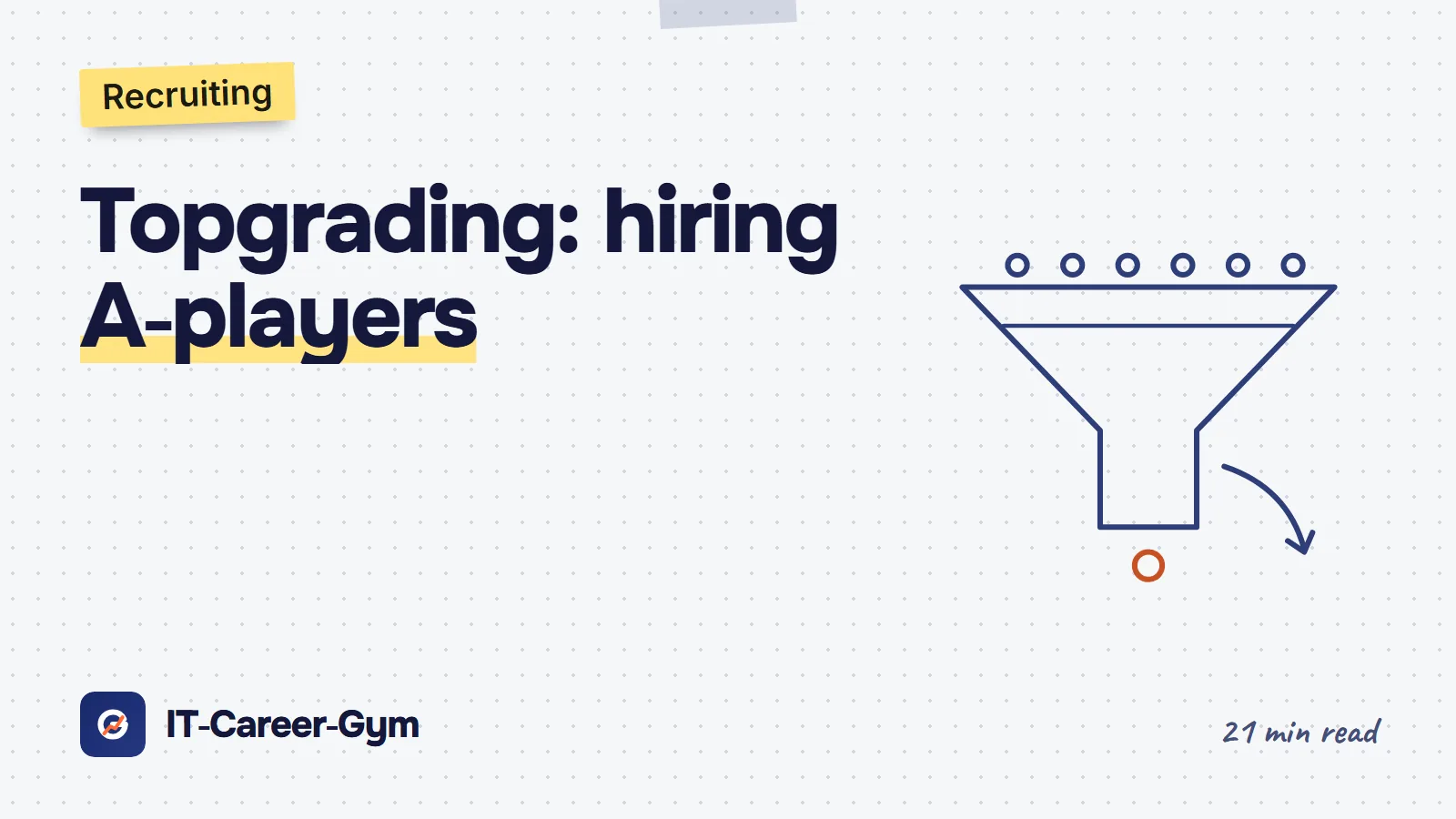
The book has five substance stages: screening, Engagement, the Topgrading interview itself, focused rounds, references. Sourcing and the offer are the funnel edges, not a contradiction of “five stages.”
Sourcing
1,000+ people. A wide, diverse pool. Do not confuse it with AI filters: the neighboring piece is how sourcing tools break the process.
1. Screening → ~50
A quick filter on relevant experience. Classic Smart: a Pre-Screen Snapshot — company, role, manager’s name, self-rating “what would your manager rate you,” reasons for leaving. TORC is already on: answers must match what referees will say.
Adaptation if your brand is not a magnet yet
A long intake form can scare people off. Then a 15–20 minute phone screen with a recruiter: verify core experience and willingness to give references. That is not a Gym-hosted form and not diploma uploads into our contour.
2. Engagement → ~20
The original Topgrading method does not include this round. Teams add it so they do not burn 1.5 hours on someone with no chemistry. For the candidate: market, product, team pain, leadership style. Key question: “After all this, are you still excited?” No spark — stop. On interviewer culture — why interviewers get it wrong.
3. Topgrading interview → ~5
The heart of the method. The hiring manager runs it — the person who owns success or failure of the hire. 1.5 hours for ICs and managers, up to three hours for senior execs. Scope: last 10 years, or 3–5 roles for more junior people.
Conversation structure: activate TORC again, then chronology. For each role — the five pillars:
| Pillar | Questions |
|---|---|
| Why | Why did you join this company? Why this role? |
| What | Key responsibilities and goals. |
| Successes | Proudest achievements? Numbers, names, obstacles — not “the team achieved.” |
| Failures | Mistakes and regrets. What would you do differently? |
| Feel | What did you like and dislike about the job? About your manager? |
Management module: A/B/C mix on the team you inherited; how it changed (training, firing, coaching); who your manager was and how the relationship worked.
Reference prep: “When we talk to [manager’s name], what will they name as your top 3 strengths? Top 3 development areas? A 1–10 rating?” Exit: why did you leave?
Juniors have few jobs — apply the same logic to university, internships, school projects: decisions, resilience, work ethic. Do not upload diplomas to Gym. Gather the five pillars on an express quiz as a structure, then out loud on a mock.
4. Focused interviews → 2–3
Proof of skill with future peers. An A-Player leader can fail an IC round without the code. A brilliant IC can be a weak people manager. Examples: architect — whiteboard system design (guides like Amazon); line manager — coaching a struggling employee; senior exec — a strategy presentation and Q&A. Hard skills on the platform — an express quiz, not a LeetCode clone.
5. References → 1
Validate the story and uncover hidden risk. Contacts: all managers and 1–2 key peers from the last 10 years. Refusing a manager contact is a major red flag. The hiring manager places the call: they have the full Topgrading context.
| Purpose | Question for the referee |
|---|---|
| Context | Tell me about working with them. |
| Strengths | What did they do better than anyone else? |
| Development areas | Where did they struggle? |
| Match | If we hire for [role], how would they fit? |
| Specifics | Ask about a weakness the candidate already named: the referee knows the person is aware, and lies less. |
Offer
One person. You found an A-Player. “Hell, yeah!” is not an Excel chart — it is the feeling after the Scorecard lines up.
How to make the final decision
After these steps you have more data than “an hour on a call and an offer from the ceiling.” Two guides: notes, and the Scorecard from day one.
- Re-read notes from every stage.
- Walk the Scorecard as a checklist: mission, 90 days, competencies.
- If you have a few finalists — put them side by side on the same cells, not “who was nicer on the call.”
The 90% rule. A 100% match is rare. If someone already hits about 90% and you believe they can learn the rest — it is time to offer. Do not wait for the unicorn from the reality-check row.
Beyond the hire: retain and develop
Topgrading does not end at the signature. A-Players must not be “closed in Jira” — keep the bar. Coach B toward A or honestly rethink the role. Leaving C “for later” is more expensive than it looks: they eat manager attention and spoil the people you just hired.
A-Player magnet works both ways: strong people stay next to strong people. If after the offer the team grows average again, you bought a process, not a result.
How to start at IT Career Gym
First, honestly assess the process you have today.
Small team. The hiring manager runs Engagement and Topgrading. There is no “recruiter inside Gym.” Employers — the landing; people who already practiced — rating; publish a role (a JD, not a Scorecard) — vacancies.
Large enterprise. Do not break your HRIS for us. Champion Scorecard and TORC inside the workflow you already have. Gym does not plug in as a mandatory module and does not promise an enterprise Smart ATS.
Candidates about to be topgraded: the five pillars and failures — on a mock and in STAR; focused skill — in an express quiz; work that is not on public GitHub — in a pet project; a resume of outcomes, not duty lists — resume.
Takeaways: four pillars
Topgrading is not an HR checklist. It is a mindset. More work up front, less cost of a bad hire.
- A meticulous Scorecard: know who you need before the first call.
- TORC: honest people stay in the funnel. The employer places the calls, not Gym.
- The full Topgrading interview: patterns from the past, not “tell me about yourself for 40 minutes.”
- Thorough references: verify the story with people who worked next to them.
Keep the bar high. The prize is a team of A-Players, not a closed slot in a tracker.
FAQ
Only one row stays open. These are answers on Topgrading, not a glossary.
-
Is this only for C-level and FAANG?
No. The method started with executives, but Smart writes about managers, team leads, and ICs. For ICs the depth is the last 3–5 roles, not a three-hour CEO marathon. A candidate should run the pattern on a mock, not memorize “correct” answers.
Link to this answer -
Will TORC scare off strong people? And is it even allowed in Russia?
Per Smart, A-Players give references quickly. Gym does not call employers and does not store referee contacts — that is not our personal-data processing. Calls stay with the hiring manager and the candidate’s consent; this article is not legal advice. If you have nothing to hide, you prepare stories on a mock.
Link to this answer -
Three hours of chronology for a mid-level engineer — overkill?
In the canon: 1.5 hours for ICs and managers, up to three for senior execs. Do not stretch a mid-level loop to CEO length. Engagement cuts “no spark” before the heavy round. How to lead when the interviewer is unprepared — in the neighboring article.
Link to this answer -
Refusing manager contacts for 10 years — automatic no-hire?
In the text it is a red flag, not the only criterion. Watch the pattern across all pillars. Gym rating does not replace a reference call.
Link to this answer -
Where is Topgrading itself inside Gym?
Nowhere as a product. The Scorecard is your internal document. The platform is candidate practice and an employer surface — for employers, rating, vacancies, mock, quiz, pet project. That is not Smart’s ATS.
Link to this answer
You do not guess A-Players from a resume
The hiring manager holds the Scorecard. The candidate narrates the past on a mock. Gym will not hire an A-Player for you and will not sell Super as an “offer guarantee.”
Also related: AI sourcing · Why AI will not replace the recruiter · Interviewer mistakes · STAR stories